Katha to Square Feet Conversion Guide: A Practical Resource for Indian Land Buyers and Farmers
Introduction
When dealing with land measurement in India, especially in states like West Bengal, Bihar, and Assam, the unit Katha is commonly used. However, for many practical purposes including buying, selling, or developing land, square feet is a more universal and understandable unit. This guide will help you understand how to convert Katha to square feet accurately, avoid common mistakes, and provide useful resources for related land unit conversions.
What is Katha?
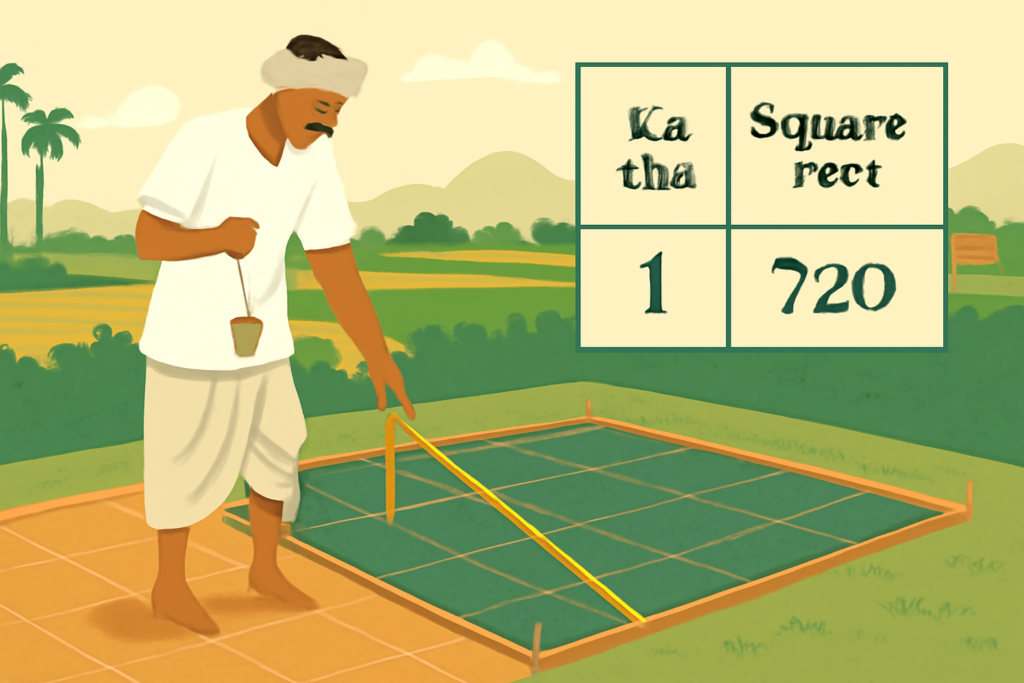
Katha is a traditional unit of land measurement used in some Indian states. The exact size of a Katha can vary significantly depending on the local region or state. For example, in Bihar, 1 Katha is typically equal to 1361 square feet, while in West Bengal, it can be 720 square feet. Because of these variations, it is important to verify the local conversion values from official or trusted sources before making any calculations.
Formula to Convert Katha to Square Feet
The general formula to convert Katha to square feet is:
- Square Feet = Number of Kathas × Size of One Katha in Square Feet
Since the size of a Katha varies, the key is to know the local equivalent in square feet.
Example Calculation
Suppose you are in Bihar where 1 Katha = 1361 square feet. If you have 5 Kathas of land, the conversion to square feet will be:
| Number of Kathas | Size of One Katha (sq ft) | Total Square Feet |
|---|---|---|
| 5 | 1361 | 5 × 1361 = 6805 sq ft |
Therefore, 5 Kathas of land equals 6805 square feet.
Common Mistakes to Avoid
- Ignoring Regional Variations: As mentioned, Katha size varies by state. Using a general conversion without confirming the local standard can lead to significant errors.
- Confusing Katha with Other Units: Katha is sometimes mixed up with units like Bigha or Gunta. Each has its own conversion rate, so be sure which unit you are dealing with.
- Rounding Off Too Early: When performing calculations, avoid rounding off intermediate values. Calculate precisely and round only the final result if necessary.
- Not Consulting Local Records: Always check local land records or trusted sources for the exact value of Katha in your area.
Additional Resources
For those interested in other land unit conversions, LandMeasure.in provides several handy calculators and guides:
- Katha to Square Feet Calculator – Quickly convert Katha to square feet with an easy-to-use tool.
- Gunta to Square Feet Calculator – Useful for regions where Gunta is used.
- Comprehensive Land Units Guide – Learn about various Indian land measurement units.
- State-wise Land Measurement Guides – Understand how land units vary across different Indian states.
Frequently Asked Questions (FAQs)
1. Is the size of a Katha the same everywhere in India?
No, the size of a Katha varies by state and sometimes even by district. Always verify the local conversion factor before calculations.
2. How can I find the exact size of Katha in my area?
Check your local land records, government websites, or trusted land measurement resources like LandMeasure.in state guides for accurate information.
3. Can I use the same formula to convert other units like Bigha or Gunta?
The principle is the same, but the conversion factor differs. For Bigha or Gunta conversions, refer to specific calculators such as the Bigha to Acre Calculator or Gunta to Square Feet Calculator.
4. Is this guide legally binding for land transactions?
No, this guide is for informational purposes only. Land unit values can vary and for legal transactions, always consult official records or legal professionals.
Conclusion
Converting Katha to square feet is a straightforward process once you know the local size of a Katha. Always confirm the conversion factor applicable in your region to ensure accuracy. Using tools like the Katha to Square Feet Calculator can simplify your calculations. Remember, understanding land units is essential for buyers, farmers, real estate professionals, and students working with Indian land measurements.
Note: Land unit values such as Katha, Bigha, Marla, and Kanal can vary by state and local records. This article does not provide legal advice or represent official government standards.